
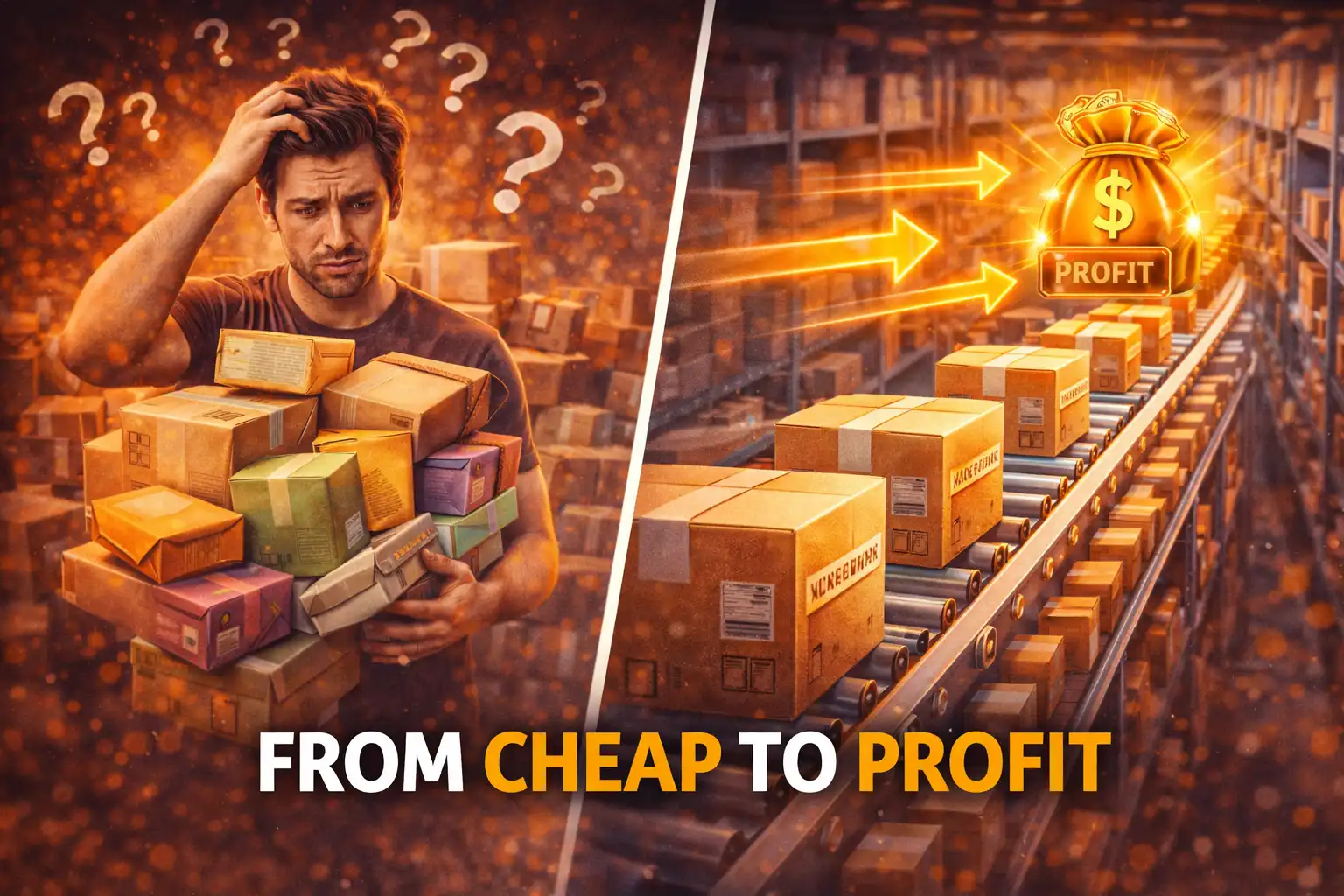
Most people look at AliExpress and see cheap products.
A smaller group sees something else entirely.
They see access to suppliers, pricing advantages, and product variety that simply doesn’t exist in local marketplaces. But here’s the difference that matters: not everyone who sees opportunity can actually turn it into profit. Because AliExpress is not a shortcut to easy money. It is a system that only works if you understand how to use it correctly.
If you treat it like a place to “buy cheap and resell,” you will struggle. But if you treat it like a supply infrastructure that needs to be managed, tested, and controlled, it can become a consistent source of profit. The platform itself doesn’t guarantee results. Your strategy does.
Why most people fail before they even start
There is a common pattern among beginners.
- they find a cheap product
- they assume they can resell it easily
- they order small quantities
- they expect fast turnaround
Then reality hits. Shipping takes time, product quality varies, and demand is not as simple as they imagined. At this point, many people conclude that AliExpress is unreliable or not suitable for business.
👉 The truth is, they approached it with the wrong model.
They tried to force a local reselling mindset into a global sourcing system. And that mismatch is what causes failure, not the platform itself.
The moment it becomes a real business opportunity
AliExpress becomes powerful when you stop thinking like a buyer and start thinking like a system builder.
Instead of asking:
👉 “Can I make money from this product?”
You start asking:
👉 “Can I build a repeatable supply for this product?”
That shift changes everything. Because profit does not come from one good product. It comes from consistency — consistent sourcing, consistent availability, and consistent margin.
What actually makes a product profitable in this system
A product is not profitable just because it is cheap.
It becomes profitable when three things align:
- sourcing price is stable
- supply is consistent
- demand exists in your market
If one of these is missing, the system breaks.
This is why experienced sellers don’t chase random trending items. They look for products that can be sourced repeatedly without disruption. Stability matters more than hype.
Where supply strategy becomes more important than product choice
This is the part most people underestimate.
Even with a good product, if your supply is unstable, your business will struggle. Delays, stockouts, and inconsistent shipping will directly affect your ability to sell.
That’s why building a supply system is more important than finding “the perfect product.”
A simple but effective structure looks like this:
- order consistently, not occasionally
- maintain buffer stock
- never wait until inventory is empty
- separate urgent and non-urgent shipments
👉 This is how you turn AliExpress into a reliable supplier.
Why flow matters more than speed
One of the biggest misconceptions is that fast shipping equals good business.
That’s not always true.
What matters more is:
👉 predictability
If you can predict when your stock arrives, you can plan sales, manage inventory, and avoid downtime. Even if shipping takes 30 days, it becomes manageable when it follows a pattern.
This is why many experienced sellers continue using economy shipping — not because it’s fast, but because it’s consistent over time when managed properly.
The hidden advantage of starting small but structured
Many beginners think they need large capital to start.
That’s not always necessary.
What matters is structure.
Instead of:
- importing large quantities at once
- risking high upfront cost
You can:
- split orders into smaller batches
- test demand gradually
- scale based on actual sales
👉 This reduces risk while still building momentum.
When you start to see AliExpress differently
At some point, your perspective changes.
You stop seeing it as:
- a place to find cheap items
And start seeing it as:
- a network of suppliers
- a flexible sourcing system
- a controllable inventory pipeline
This is where real opportunity begins.
Because now you are not guessing anymore. You are building something that can be repeated.
The part most people only understand after trying
AliExpress is not difficult.
But it punishes careless usage.
If you:
- rely on one supplier
- ignore shipping structure
- don’t plan inventory
👉 you will struggle
But if you:
- build relationships with sellers
- understand shipping methods
- manage stock properly
👉 the system starts working for you
Why this can work across multiple marketplaces
This strategy is not limited to AliExpress alone.
Once you understand how to:
- source products
- manage supply flow
- control inventory
You can apply it to:
- eBay
- Amazon (FBM or hybrid models)
- other global marketplaces
Because the core principle remains the same:
👉 supply control creates profit opportunity
If you want to explore product ideas and sourcing patterns used by other buyers:
When everything finally connects
In the end, AliExpress is not a business by itself.
It is a tool.
And like any tool, its value depends on how you use it.
If you use it casually, results will be inconsistent.
If you use it strategically, it can become a stable part of your business.
👉 The opportunity is real — but only for those who understand the system.
A question worth thinking about
Are you still looking for “cheap products to resell”…
or are you ready to build a system that can generate consistent profit over time?