
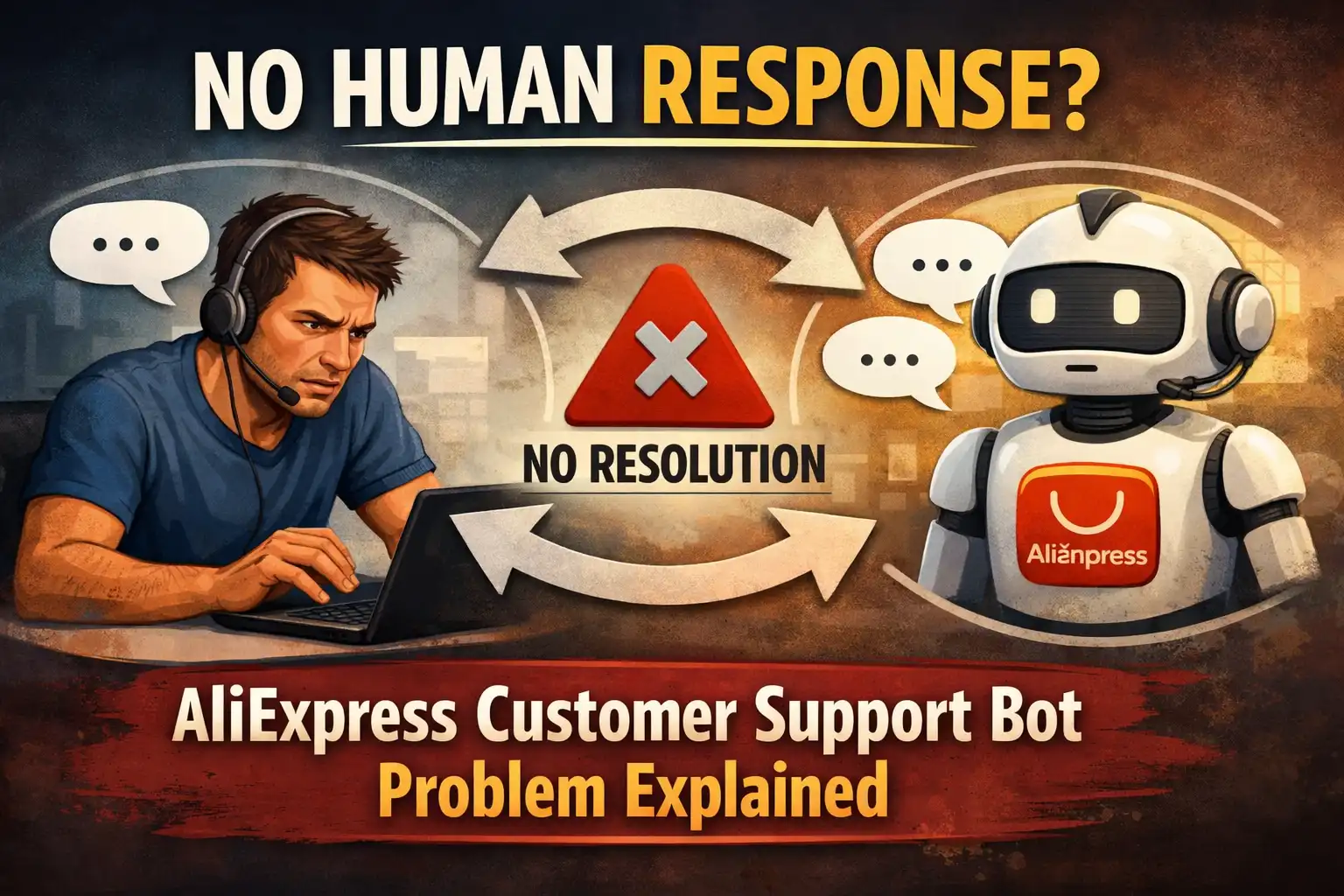
At some point, many buyers run into the same wall.
They try to contact customer support, expecting help, clarification, or at least some form of resolution. But instead of a clear answer, they receive responses that feel repetitive, generic, and disconnected from the actual problem. It feels like no one is really listening.
That’s when frustration starts to build.
Not because the problem itself is unsolvable—but because the process of getting help feels empty. And over time, this creates a deeper concern that goes beyond just support quality.
It starts to feel like the system is there… but no one is actually behind it.
Where the frustration really begins
At first, the experience seems normal.
You reach out, you get a reply, and technically the system is “responding.” But as the conversation continues, something feels off. The answers don’t fully address your issue. The wording feels repetitive. The responses seem structured, not adaptive.
This leads to a very common perception:
- “I’m not talking to a real person”
- “This feels like a bot”
- “No one is actually solving my problem”
👉 And that perception is powerful
Because even if the system is functioning, the experience feels disconnected.
When support feels present, but not helpful
This is where the issue shifts from technical to emotional.
Support exists. Responses are being sent. But the outcome doesn’t change. The problem remains unresolved, and the user is left repeating the same explanation over and over again. This creates a loop that feels unproductive.
In many cases, especially during disputes, users report difficulty escalating the issue to a human representative. The system continues to respond, but without meaningful progress.
👉 This is where frustration turns into distrust
Because now it’s no longer about solving a problem—it’s about whether the system is actually willing to help.
Why this feels worse than having no support at all
Interestingly, this experience can feel worse than having no support.
When there is no support, expectations are clear. But when support exists and still doesn’t resolve the issue, it creates a mismatch between expectation and reality. The user expects help but receives something that feels automated and ineffective.
This gap is what amplifies the frustration.
It’s not just about slow replies or generic answers. It’s about the feeling that the system is not truly engaged in solving the problem.
The deeper layer: this is not just a UX issue
At first glance, this might look like a user experience problem.
Maybe the interface is not intuitive. Maybe the responses are too standardized. Maybe automation is overused. All of these are valid observations.
But the real issue goes deeper.
👉 This is a trust issue
When users feel like they cannot reach a real solution—or a real person—they begin to lose confidence in the platform itself. Not because of one bad interaction, but because the system feels distant and unresponsive when it matters most.
Why large platforms rely heavily on automation
To understand this properly, you also need to look at the scale.
Platforms like AliExpress handle massive volumes of transactions daily. To manage this, they rely heavily on automation systems to:
- filter common issues
- provide instant responses
- handle high traffic efficiently
From a system perspective, this makes sense.
But from a user perspective, especially when dealing with complex problems, it creates friction. Because not every issue fits into a predefined template.
When automation stops being helpful
Automation works well for simple questions.
But when a situation becomes specific—like disputes, delivery issues, or unexpected problems—users need:
- context-based understanding
- flexible responses
- actual decision-making
👉 And this is where automation starts to fall short
Because it cannot fully adapt to every unique case.
How experienced users navigate this differently
Over time, some users learn to work around this limitation.
They:
- provide very clear and structured evidence
- follow dispute procedures carefully
- avoid relying on back-and-forth conversations
- focus on documentation instead of explanation
This doesn’t eliminate the issue, but it increases the chances of reaching a resolution.
What you can realistically expect from the system
It’s important to align expectations here.
Customer support in large marketplaces is designed to handle scale first, and complexity second. That means:
- simple issues → resolved quickly
- complex issues → slower, less flexible
Understanding this helps reduce frustration.
Because now you’re not expecting a personalized support experience—you’re working within a structured system.
If you want to explore how experienced buyers structure their decisions to avoid reaching this stage in the first place, you can take a look here:
These examples reflect how product selection, seller filtering, and buying strategy are used to reduce dependency on support systems.
When everything becomes clearer
AliExpress support is not necessarily broken.
But it is designed differently from what many users expect.
It prioritizes:
- scale
- efficiency
- structured handling
Not:
- deep personalized interaction
👉 And once you understand that, the experience becomes easier to navigate
A simple question to reflect on
Are you expecting the system to behave like personal support…
or are you starting to understand how it actually operates at scale?