
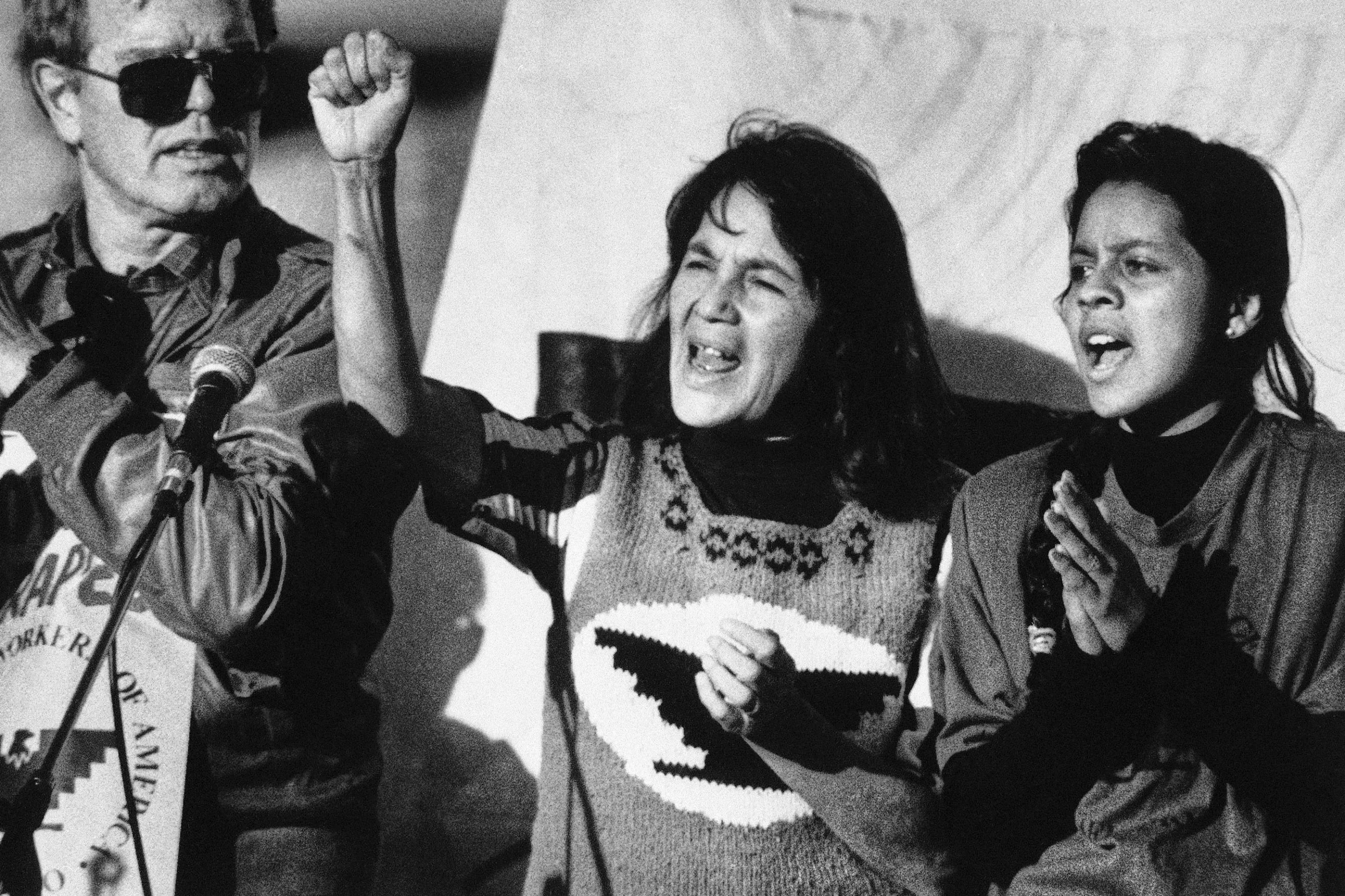
The landscape of American social justice and labor organizing has lost one of its most enduring pillars. Dolores Huerta, a pioneering feminist, civil rights champion, and labor leader who helped shape the American labor movement, has passed away at the age of 96. Her family announced through her foundation that she died at home, concluding a lifetime dedicated to fighting for the marginalized and reshaping the political and economic realities of agricultural workers.
Born Dolores Clara Fernandez in Dawson, New Mexico, in 1930, Huerta’s early life laid the groundwork for her lifelong commitment to advocacy. Following her parents’ divorce when she was three, she moved with her mother and brothers to California. Growing up in a diverse working-class environment, she absorbed lessons of independence and community organizing from her mother. Before stepping into full-time activism, Huerta worked as an elementary school teacher in the San Joaquin Valley. Her frustration over seeing students arrive hungry and lacking proper shoes prompted a profound career pivot, leading her to conclude that organizing farmworkers would create a broader impact than teaching individual classrooms.
Building the United Farm Workers and Coining a Movement
Huerta’s activism crossed paths with César Chavez through civil rights work in Stockton. Sharing a deep concern for the harsh conditions faced by agricultural laborers, the two co-founded the National Farm Workers Association in 1962, which later evolved into the United Farm Workers of America. As a key negotiator and strategist, Huerta stood on the picket lines alongside Filipino grape pickers during the historic five-year Delano Grape Strike.
Working alongside Chavez, she successfully negotiated collective bargaining agreements with major agricultural growers, securing vital health and benefit plans for workers who had long been denied basic protections. Beyond field contracts, Huerta mastered the art of political lobbying, helping secure unemployment financial aid, disability insurance, and the legislative framework for California to become the first state recognizing farmworkers’ collective bargaining rights. Her efforts also included directing nationwide boycotts of grapes and lettuce and speaking out against toxic pesticides.
Among her most enduring cultural contributions was co-coining the phrase “Sí, se puede!”—translating to “Yes, it can be done”—which evolved into a widespread rallying cry grounded in the belief that ordinary citizens could enact systemic change. Her decades of frontline activism came with personal risks; she was arrested 22 times and suffered severe injuries during a 1988 protest in San Francisco when she was struck by a police officer’s baton, later reaching a legal settlement with the city.
Accolades, Later Activism, and Complex Legacy
Huerta’s immense impact was recognized with numerous accolades, most notably the Presidential Medal of Freedom, which was presented to her by then-President Barack Obama in 2012. She was also the first Latina inducted into the National Women’s Hall of Fame, received nine honorary doctorates, and saw numerous schools and streets named in her honor.
In her later decades, Huerta shifted her focus toward championing women’s rights, encouraging Latinas to run for political office, and campaigning for various Democratic presidential candidates, including Bill Clinton, Barack Obama, and Joe Biden. She maintained an active schedule well into her nineties, traveling and speaking on behalf of her Bakersfield, California-based foundation regarding race, poverty, LGBTQ+ rights, and gender equality.
In recent years, Huerta also touched upon deeply personal matters, publicly revealing details from her past, including her relationship with César Chavez’s brother, Richard Chavez, who was her life partner from the early 1970s onward. Her enduring legacy remains defined by her fierce dedication to justice, labor rights, and the empowerment of workers across the United States.