
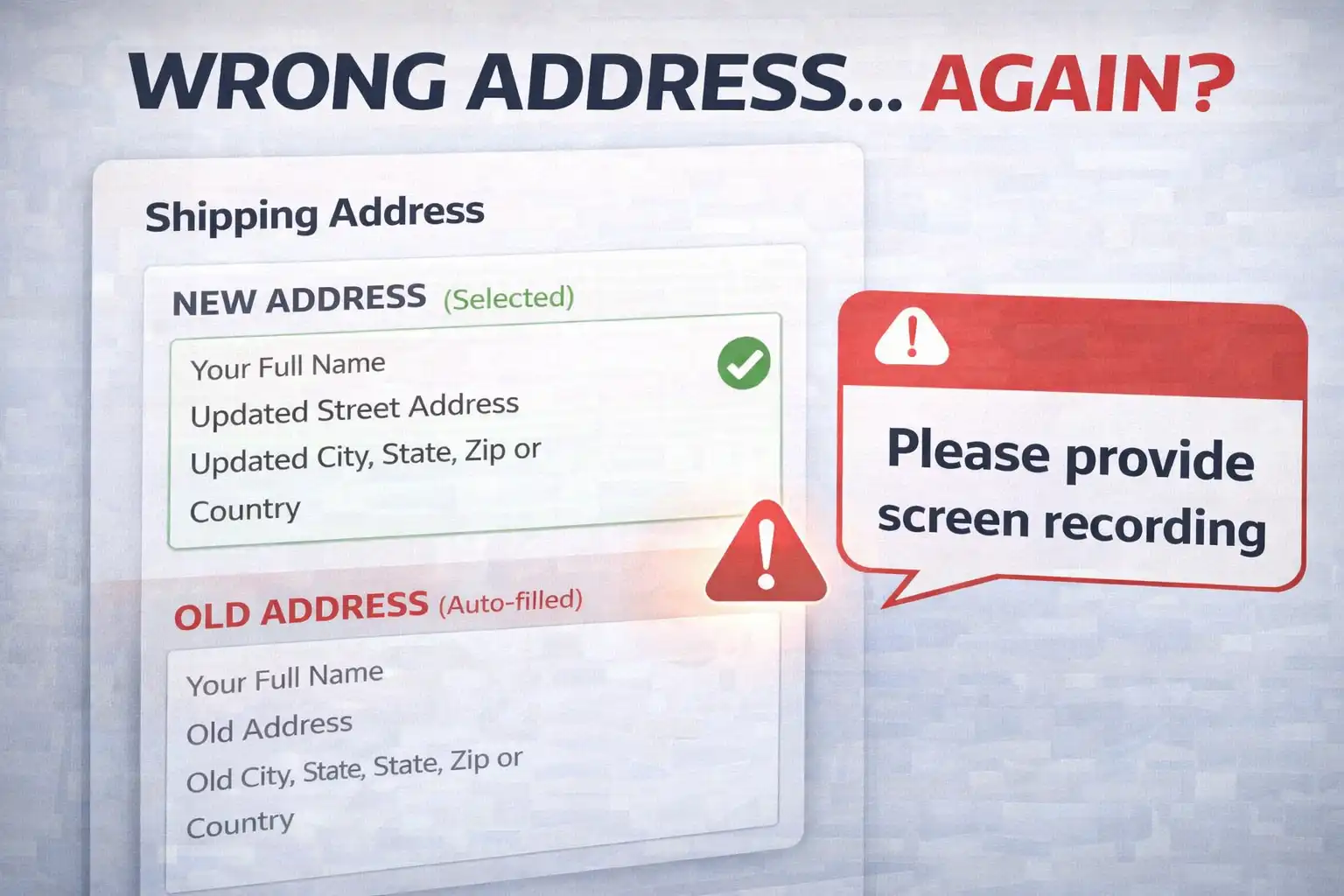
You update your shipping address.
You double-check it.
You place your order.
Weeks later… your items are sent somewhere you lived five years ago.
At that moment, the problem feels obvious:
The system used the wrong address.
But what happens next is where many buyers start to feel something else entirely:
The burden of proof shifts… to you.
And sometimes, it escalates to requests that feel completely unreasonable — like being asked for a screen recording of something that already happened.
When a Simple Address Change Turns Into a System Problem
Let’s slow this down.
You didn’t forget to update your address.
You didn’t input it incorrectly.
You changed it inside the app.
Yet somehow, the order still defaulted to an old address.
This creates a very specific type of issue:
👉 not a user mistake
👉 not a seller mistake
But something in between:
👉 a system-state mismatch
What Likely Happened Behind the Scenes
Most buyers assume that when they update their address, it becomes the single source of truth.
But in large marketplace systems, it’s often more complicated than that.
There can be multiple layers:
| System Layer | What It Controls |
|---|---|
| Account profile | Saved default address |
| Checkout session | Temporary address snapshot |
| Order system | Final locked address |
| App cache | Stored local data |
Here’s the key insight:
👉 Updating your address does NOT always update every layer instantly.
The “Snapshot” Problem (This Is Critical)
When you place an order, the system may take a snapshot of your data at that exact moment.
If something goes wrong during that process:
- the old address might still be cached
- the new address might not sync properly
- the system may revert to a previous default
Think of it like editing a document… but printing an older saved version by mistake.
To you, the document is updated.
To the system, it’s still using the previous version.
Why the Platform Asks for a Screen Recording
Now here’s the part that feels insane:
“Please provide a screen recording showing the steps you took…”
From a human perspective, this feels unreasonable — because the action already happened.
But from the system’s perspective, this request has a purpose.
They are trying to answer one question:
Did the error happen because of user input… or system behavior?
A screen recording would theoretically show:
- whether the address was correctly updated
- whether the UI responded properly
- whether the system reverted automatically
But Here’s the Real Problem
This type of request reveals something deeper:
👉 the system cannot reconstruct what happened internally
So instead of:
- checking internal logs
- verifying system behavior
It shifts the investigation to the user.
Why This Feels Like “Being Worn Down”
Because the process becomes:
- You report the issue
- They ask for more data
- You provide it
- They ask for even more specific proof
At some point, the request crosses a line where it’s no longer practical.
A screen recording of a past action is not just difficult —
it’s often impossible.
And that’s where the experience changes from:
“They are helping me”
to
“They are exhausting me”
Why Support Responded Faster on Trustpilot
You mentioned something very interesting:
👉 They responded quickly when you posted publicly.
This is not accidental.
Public platforms create:
- reputational pressure
- visibility
- urgency
So responses tend to be faster and more structured.
But once the case moves back into internal systems, it returns to:
👉 process-driven handling
👉 template workflows
👉 documentation loops
What’s Actually Being Misunderstood Here
Many buyers assume:
“If the system made a mistake, they will fix it.”
But in reality, most platforms operate like this:
👉 The system does not assume fault — it requires proof of fault.
Even when the situation feels obvious.
A Simple Analogy That Explains Everything
Imagine sending a package using a machine.
You input the correct address.
But the machine prints the old one.
Now you complain.
The system responds:
“Can you show us a video of you entering the correct address?”
Not because they don’t believe you —
but because their system cannot verify it internally.
Where the Real Friction Comes From
The issue is not just the wrong address.
It’s the combination of:
- distributed system layers
- lack of internal traceability
- rigid support workflows
- reliance on user-provided evidence
When all of these combine, even a simple issue becomes complicated.
What Experienced Buyers Learn From This
After encountering cases like this, many buyers become more cautious with:
- address verification before checkout
- placing high-value or multi-item orders
- assuming system changes are fully applied
Some even re-check address inside the final order page, not just the profile.
Because that’s the only layer that truly matters.
Explore Smarter Shopping Patterns
If you want to reduce situations like this, it helps to understand how real buyers navigate these systems.
You can explore curated insights and product trends here:
Sometimes the best protection is understanding the system before it fails.
Final Thought
This situation leaves a very specific feeling:
“I did everything right… so why am I proving it?”
And that’s the moment many buyers realize something important:
👉 the system is not built to assume correctness
👉 it’s built to validate through structure
And when that structure breaks —
the burden quietly shifts to you.
What Do You Think?
Have you ever updated your address correctly, but the system still used the wrong one?
And when you tried to explain it… were you asked for proof that didn’t even make sense to provide?
Your experience might help others avoid the same situation.