
Democratic Edge on the Congressional Ballot
As the country looks toward upcoming electoral matchups, a fresh collaborative survey conducted by NPR, PBS News, and Marist provides a detailed snapshot of voter sentiment. Released following interviews with a national sample of registered voters from October 19 to 20, 2026, the data indicates that Democrats retain significant electoral advantages. Most notably, they maintain a clear edge on the generic congressional ballot, positioning them as favorites in the battle for control of the U.S. House.
Among registered voters surveyed, Democrats hold a 10-point advantage regarding which party’s candidate respondents plan to support in their local districts. When filtered through a likely voter screen, that advantage shifts slightly to 8 points. Historically, commanding leads of this magnitude on generic congressional ballots have preceded strong election cycles for the party, such as the 7-point advantage in 2018 and the 12-point margin in 2006, both of which resulted in Democrats capturing the House with at least 30 flipped seats.
However, analysts note that structural changes since those previous cycles could alter historical outcomes. Regular post-2020 Census redistricting, alongside rare mid-decade map redraws initiated after requests from Donald Trump in Republican-led states—and subsequent Democratic responses—have tilted numerous congressional districts in ways that provide Republicans with relative national advantages. Consequently, a notable degree of nervousness persists among Democrats, with only 81% of Democratic likely voters believing their party’s candidate will win, contrasting with the 98% who state they intend to vote for one.
Voter Motivations, Change, and Economic Strains
Beyond party preference, the survey highlights the primary issues driving participation across ideological lines. Cost of living concerns remain central, with roughly a third of participants reporting financial hardship over the past year and 40% noting that their personal finances have deteriorated. Independent voters, such as 47-year-old Arizona resident Shun Maurice, emphasize that high food and gas prices impose a widespread strain regardless of political affiliation.
The desire for institutional change also acts as a powerful motivator. Approximately 55% of likely voters express that prioritizing candidates with fresh ideas is crucial for this election cycle. At the same time, views regarding President Donald Trump heavily influence the electorate. Only 38% of registered voters approve of his job performance, with 61% expressing disapproval, and 53% stating they strongly disapprove. Furthermore, likely voters are twice as likely to frame their ballot as a vote against Trump rather than an endorsement.
Despite Trump’s low approval and favorability ratings—standing at 37% favorable among likely voters—political dynamics remain complex. Some swing voters express wariness not just toward the administration, but also regarding shifts within certain factions of the Democratic Party toward democratic socialism, indicating that voter decisions involve multifaceted ideological calculations rather than simple binary choices.
Enthusiasm Gaps and Institutional Trust
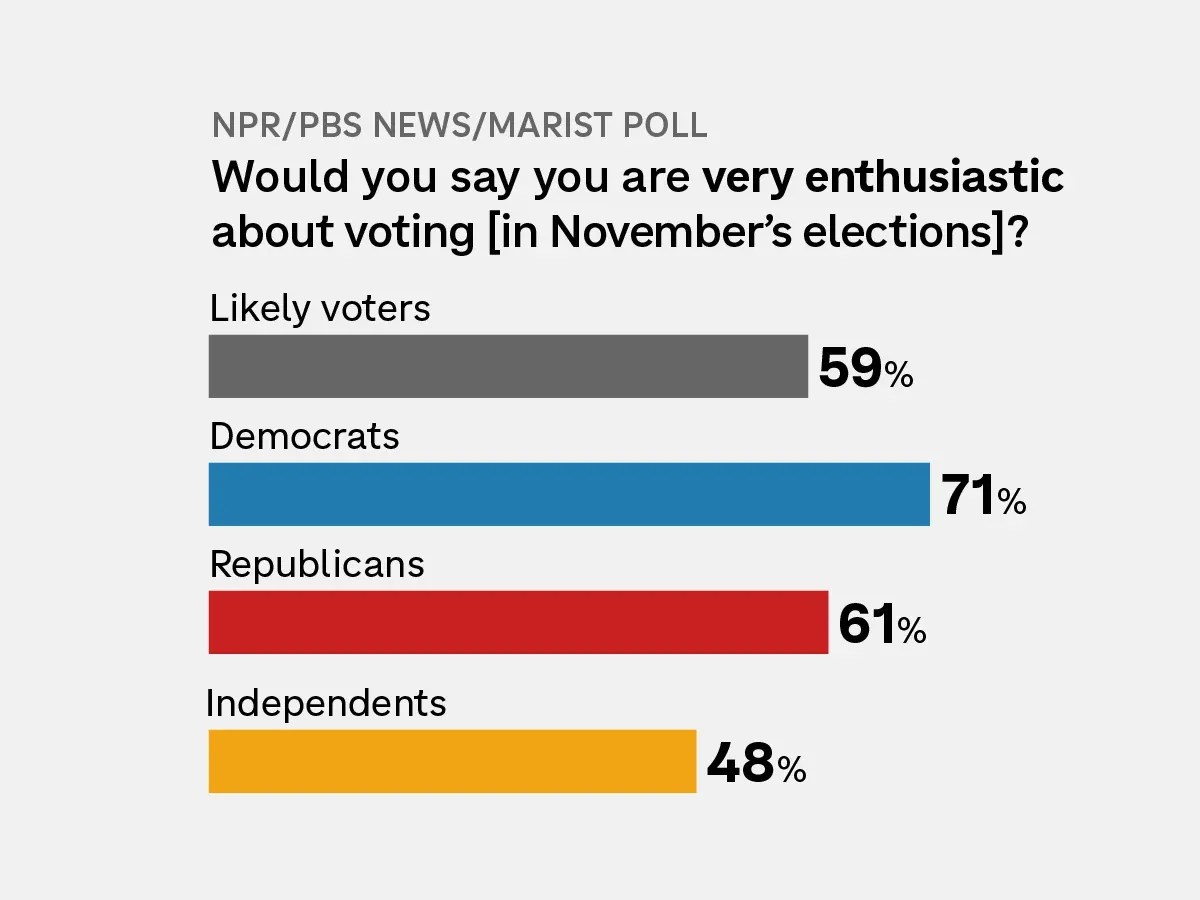
While Democratic likely voters demonstrate higher overall enthusiasm compared to their Republican counterparts—71% to 61% reporting they are very enthusiastic—caution signs appear within specific demographic pillars. Lower enthusiasm levels are recorded among voters under 45 (42%), non-white voters (53%), and college-educated white women (56%), all groups that lean toward disapproving of the current administration. Conversely, pro-movement cohorts like MAGA supporters (68%), non-college white women (66%), and white evangelicals (61%) report higher engagement.
Regarding election administration, three-quarters of likely voters express confidence that local and state governments will manage fair and accurate elections. Majorities across Democrats, Republicans, and independents share this trust, though partisan gaps remain apparent. Majorities also believe candidates should accept final results, though subsets of respondents express differing views on post-election legal challenges.