
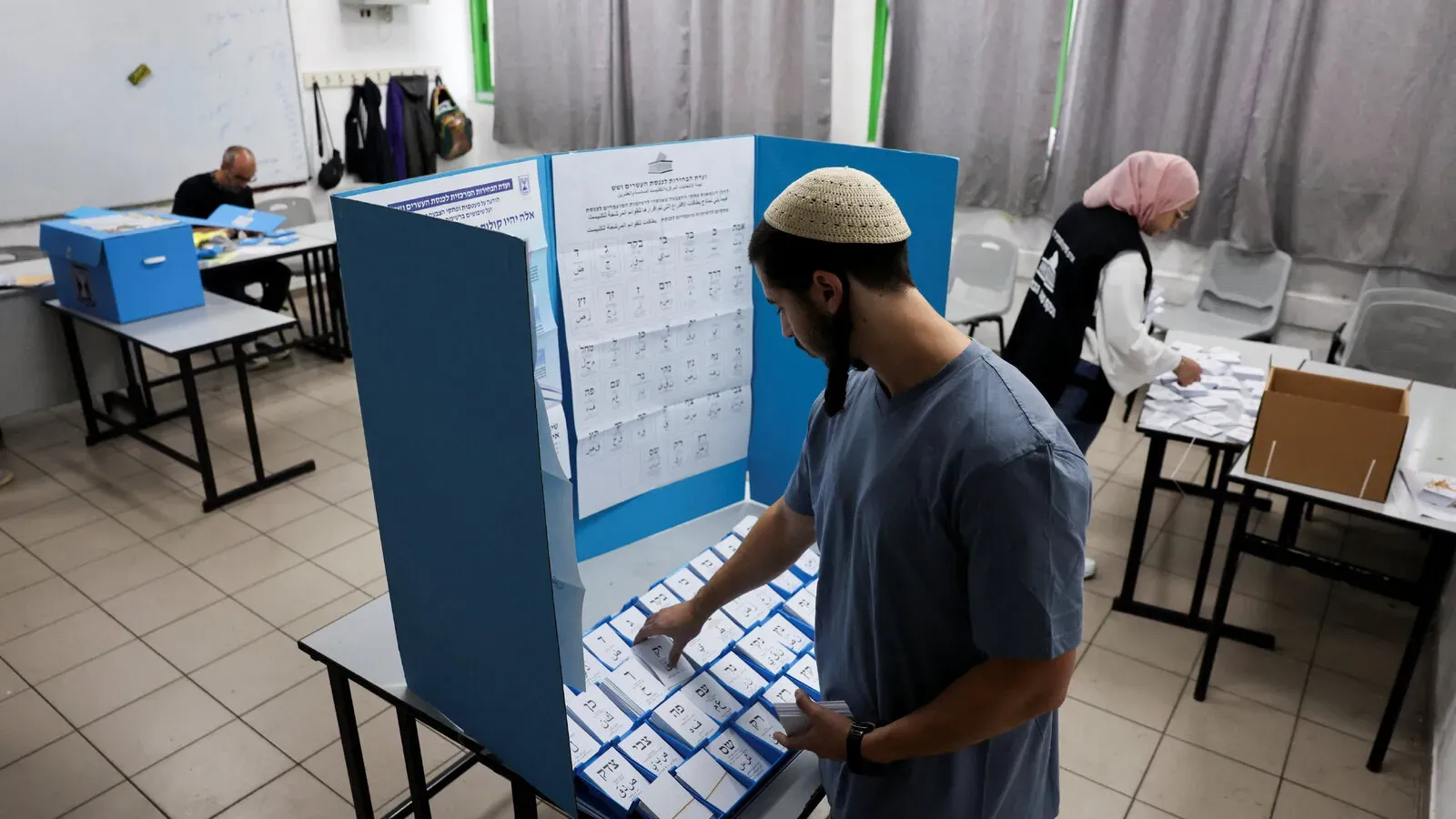
Voters across Israel headed to the polls for a general election widely viewed as a decisive referendum on the long-standing leadership of Prime Minister Benjamin Netanyahu. Marking the country’s first national vote since the October 7, 2023, attacks and the subsequent three years of war, the election presents the electorate with two sharply divergent visions for the nation’s political, social, and security future.
The election atmosphere has been defined by deep polarization and intense public debate. Over 7.3 million citizens are eligible to participate, including an estimated 630,000 individuals living overseas. Because Israel lacks a broad postal or absentee voting system from abroad, many expatriates, including thousands residing in the United States, were expected to fly back to cast their ballots. Polling stations across the country opened at 7 a.m. and were scheduled to close at 10 p.m., with adjusted hours for specific facilities such as hospitals and prisons.
The Central Contenders and Political Blocs
At the center of the political battle is Prime Minister Benjamin Netanyahu, who leads the right-wing Likud party and heads a coalition of nationalist and ultra-Orthodox factions representing the most far-right government in Israel’s history. Netanyahu, 77, has dominated Israeli politics for decades, serving as prime minister for 19 of the past 30 years. His campaign has emphasized his security credentials and opposition to a Palestinian state, while defending his administration’s handling of regional conflicts.
Opposing Netanyahu’s bloc is a fractious coalition of opposition parties loosely unified behind Gadi Eisenkot, a former military chief of staff and head of the centrist Yashar party. Eisenkot emerged as a primary challenger following a personal tragedy during the Gaza war, in which one of his sons and two nephews were killed. The opposition platform targets the current government’s vulnerabilities, focusing heavily on accountability for the security failures preceding the October 7 attacks, restoring international relations, and addressing domestic divisions over judicial reforms and military draft exemptions for ultra-Orthodox Jews.
Other key political figures and parties have shaped the intense electoral landscape. Naftali Bennett and Yair Lapid have partnered under the B’Yachad banner to unify center-right and liberal opposition elements. Meanwhile, far-right figures like Itamar Ben-Gvir of Otzma Yehudit and Bezalel Smotrich of Religious Zionism have rallied support around aggressive settlement expansion and nationalist security policies. On the political left, Yair Golan leads the Democrats, advocating for a two-state solution and secular governance.
How Israel’s Parliamentary System and Coalition Building Work
Israel operates under a nationwide proportional representation system where voters cast a single ballot for political party lists. To secure representation in the 120-seat Knesset, a party must clear an electoral threshold of 3.25 percent of the valid votes, with approximately a dozen parties projected to meet this requirement.
Because no single party has ever won an outright parliamentary majority, the outcome of Election Day serves primarily as the starting point for complex political negotiations. Following the finalization of results, President Isaac Herzog meets with faction representatives within seven days. The president typically tasks the leader of the party with the largest number of seats with forming a governing coalition.
The designated candidate is granted an initial 28-day window to forge alliances and secure the backing of at least 61 lawmakers, with a possible 14-day extension. Historical data from the Israel Democracy Institute indicates that forming a government typically requires anywhere from 20 to 100 days of intense bargaining. If the primary candidate fails to secure a majority, the mandate passes to another contender, and repeated failures can ultimately trigger new elections.
Broader Implications and International Context
The election carries profound consequences for millions of Palestinians in the West Bank and Gaza, who are excluded from participating in Israeli elections. Ahead of the vote, Palestinians in the West Bank faced strict Israeli military lockdowns. The continuation of Netanyahu’s coalition or the rise of an opposition-led government could significantly alter administrative policies, security crackdowns, and regional diplomatic standing.
International attention has also focused on the vote, with U.S. President Donald Trump publicly endorsing Netanyahu, characterizing him as a vital partner in regional conflicts. However, political analysts remain divided on whether external endorsements carry substantial weight among domestic voters navigating deep internal security and economic concerns.