
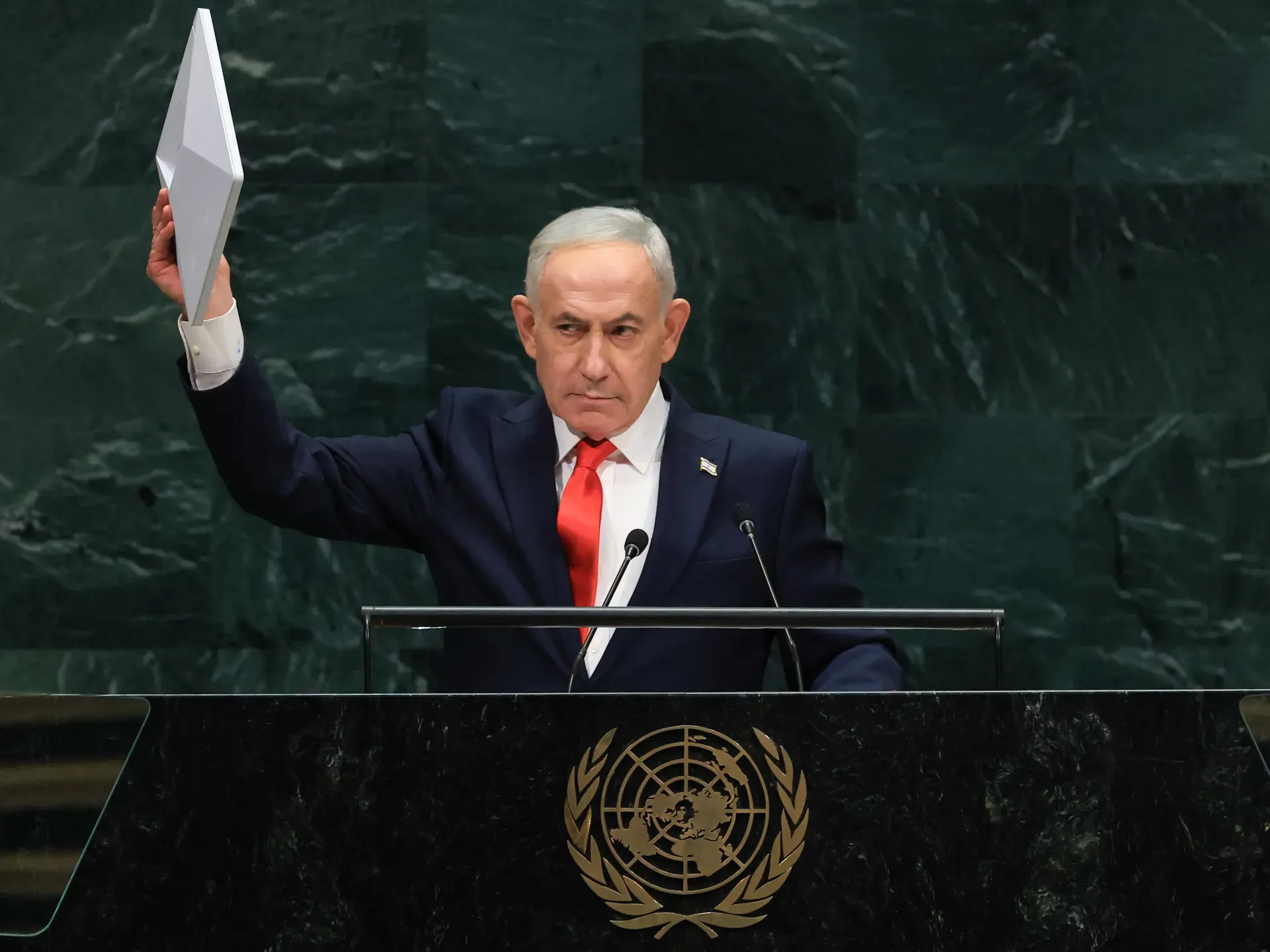
Israeli Prime Minister Benjamin Netanyahu delivered a high-stakes, combative address to the United Nations General Assembly on Thursday, leveraging the international stage to issue blistering rebukes against foreign adversaries, long-standing Western allies, and domestic critics alike. The appearance, marked by visible diplomatic walkouts and loud protests outside UN headquarters in New York, unfolded as Netanyahu faces a tightly contested battle to retain power in Israel’s upcoming national election on October 27.
As Netanyahu took the podium, dozens of international envoys exited the assembly hall in protest, accompanied by jeers from delegates, while members of the Israeli delegation applauded. Addressing the departing diplomats directly, Netanyahu labeled those turning their backs as moral cowards. Analysts noted that the rhetoric and framing of the address appeared carefully calibrated not only for global leadership but primarily for his core political constituency back home, where his survival in office remains on the line during a whirlwind trip with no scheduled meetings with top United States officials.
Sharp Rebukes for European Partners and Praise for Washington
In a rare public dressing-down of traditional partner nations, Netanyahu turned his sights toward Western Europe, specifically singling out the United Kingdom and France. Both countries have grown increasingly vocal in their condemnation of Israel’s military actions and have previously enacted limited sanctions targeting Israeli exports originating from the occupied West Bank. Responding to European accusations of colonialism, Netanyahu dismissed the claims by asserting that those very nations had originally coined the term.
In sharp contrast to his treatment of European partners, the Israeli leader offered explicit praise for US President Donald Trump, describing him as an unparalleled ally in international conflicts. Netanyahu highlighted joint military actions between the two nations, noting that US and Israeli pilots had conducted shared operations over Iran following the joint strikes launched in February against Iranian nuclear installations. He added that bilateral cooperation extended to effort aimed at securing the return of remaining hostages from Gaza.
Reframing the Seven-Front War and Regional Conflict
Addressing ongoing regional security challenges, Netanyahu declared that Israel is currently engaged in a seven-front war encompassing Gaza, the occupied West Bank, Syria, Lebanon, Iran, Yemen’s Houthis, and armed militias in Iraq. In defending the military operations against Iranian nuclear facilities earlier in the year, he characterized the decision as vital for national survival, claiming that inaction would have led to existential disaster.
Netanyahu invoked the legacy of his late older brother, Yonatan Netanyahu—who was killed in 1976 during Operation Entebbe in Uganda—reiterating a stance of mandatory victory with no alternative options. His remarks on nuclear defense followed a UN speech delivered a day earlier by Iranian President Masoud Pezeshkian, who condemned international double standards by pointing out that while Israel possesses uninspected nuclear weapons, Iran remains subject to strict international inspections and heavy economic sanctions.
Confrontation with New York Leadership and War Crime Allegations
The address also featured a direct personal attack on New York City Mayor Zohran Mamdani, who had previously stated he would advocate for Netanyahu’s arrest during his visit to the city. Accusing the mayor of attempting to silence him, Netanyahu forcefully denied charges of genocide regarding Israeli operations in Gaza, where over 73,000 Palestinians have been killed since October 7, 2023. Mayor Mamdani quickly responded to the remarks, dismissing Netanyahu’s statements as baseless assertions designed to sanitize ongoing military conduct in the Palestinian territories.
Netanyahu’s appearance at the UN occurred under the shadow of a 2024 arrest warrant issued by the International Criminal Court (ICC), which cited reasonable grounds to suspect responsibility for war crimes in Gaza—charges Netanyahu consistently denies. While the Israeli Prime Minister was permitted to attend the assembly, Palestinian President Mahmoud Abbas was denied a visa by the US administration, forcing him to deliver his UNGA address earlier in the day via a prerecorded video transmission from Ramallah.
Street Protests and the Domestic Campaign Context
Outside the UN building, human rights organizations and activist groups staged demonstrations protesting Netanyahu’s presence. Representatives from Jewish Voice for Peace accused the United Nations of accommodating a figure facing international war crime allegations, demanding an immediate halt to US military assistance. Local police detained several demonstrators during the street protests, including high-profile actor Susan Sarandon.
Reflecting on the spectacle, political analysts noted that the ultimate target audience for the fiery presentation was not the fractured UN chamber, but voters in Israel. Ariel Cohen, a senior fellow at the Atlantic Council’s Eurasia Center, observed that while the speech demonstrated strong rhetorical delivery, its primary purpose functioned like an election rally intended to consolidate domestic support ahead of the October 27 polls.