
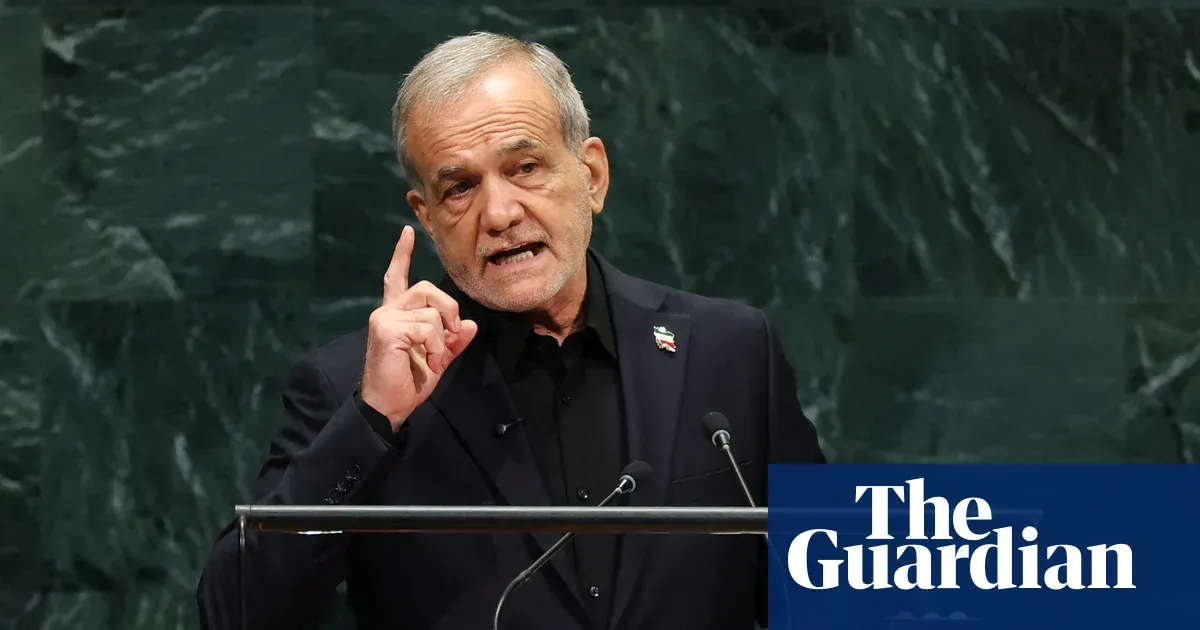
Addressing the United Nations General Assembly in New York on Wednesday, Iranian President Masoud Pezeshkian delivered a firm speech that combined harsh criticism of Washington with a clear window for diplomatic engagement. In his first UN address since the outbreak of all-out conflict involving the United States and Israel, Pezeshkian accused Washington of aggressive actions in the Middle East while stressing that Tehran remains open to negotiations, provided they are conducted without force or intimidation.
The Iranian president’s remarks arrived at a critical juncture in the conflict, characterized by heavy regional economic strain and volatile global energy markets. Pezeshkian directly responded to earlier statements by US President Donald Trump, who had told the UN assembly on Tuesday that he was considering whether to “annihilate” Iran, even while acknowledging renewed diplomatic interactions. Calling out what he described as American double standards, Pezeshkian asserted that Iran has only acted in self-defense and has never initiated military aggression.
Confrontational Rhetoric and Nuclear Stance
During his address, Pezeshkian visibly underscored the human toll of the conflict by displaying photographs of Supreme Leader Ayatollah Ali Khamenei—assassinated at the start of the war—alongside images of more than 150 schoolchildren killed during the opening days of hostilities. He strongly rejected accusations of terrorism directed at Tehran, questioning why Israel continues military operations without equivalent international penalties while Iran remains subject to widespread economic sanctions.
Addressing global concerns over nuclear development, Pezeshkian reaffirmed Iran’s position that it has the right to pursue a peaceful civil nuclear program, emphasizing that Tehran has no desire to build nuclear weapons. He argued that long-term regional security depends on cooperative agreements among Middle Eastern nations rather than external interventions by outside powers, framing neighboring countries as essential partners in regional security rather than rivals.
Side-Event Diplomacy and the Strait of Hormuz
Despite the sharp rhetoric and a walkout by the US delegation at the start of Pezeshkian’s speech, diplomatic channels have shown brief signs of movement. On the sidelines of the UN assembly, Iranian Foreign Minister Abbas Araghchi and US special envoy Steve Witkoff held a surprise three-hour meeting mediated by Qatari officials. The session marked the first direct high-level interaction between the two sides since June and was described as constructive by both parties.
Central to these discussions is the status of the Strait of Hormuz, a vital energy transit route that has experienced intermittent blockades since the war began, causing international energy prices to surge. Recent figures indicate that fewer than five identifiable oil tankers are navigating through the strait each day. The global energy bottleneck is further complicated by uncertainty surrounding the Bab al-Mandab strait in the Red Sea, where Iran-backed Houthi paramilitaries maintain significant control over key maritime choke points.
Iranian foreign ministry spokesperson Esmail Baghaei confirmed that the interaction in New York focused on conveying Iran’s explicit conditions for resolving the conflict. These preconditions include a complete end to the war, a halt to US aggressive actions, the termination of the naval blockade and economic war, and the release of frozen Iranian assets. Furthermore, Tehran indicated over the past 48 hours that the Strait of Hormuz could potentially reopen within seven days if its seven preconditions are met, though proposed navigational terms would require commercial shipping to transit primarily through Iranian-controlled sea lanes rather than Omani waters.
Domestic Resistance and Escalating Economic Pressure
The diplomatic overtures face substantial resistance within Tehran’s domestic political establishment. Mohsen Rezaei, the hardline secretary of Iran’s Supreme National Security Council, refused to label the interactions with Washington as formal negotiations. Rezaei reiterated that the Strait of Hormuz will remain closed until all of Tehran’s conditions are implemented. He also issued direct warnings to neighboring countries cooperating with US travel restrictions on Iranian flights, stating that regional airports facilitating such bans could face consequences.
Concurrently, Iran is enduring severe economic pressure driven by a comprehensive US naval blockade that has made it nearly impossible for the country to export crude oil and secure foreign currency. Civilian aviation has also encountered major operational threats due to secondary US sanctions. Despite active efforts by Iranian officials to maintain regional air links, neighboring countries including Oman and Iraq have been forced to close their airspace to Iranian civilian aircraft, raising the prospect of a worldwide grounding for Iran’s fleet.
On the American side, domestic political considerations remain highly influential. With US midterm elections approaching in November, the administration faces pressure to lower domestic oil prices and expand refined energy availability. As both governments weigh their strategic options, Pezeshkian’s UN address highlights the ongoing tension between official public posture and behind-the-scenes diplomatic maneuvering amidst an escalating regional crisis.