
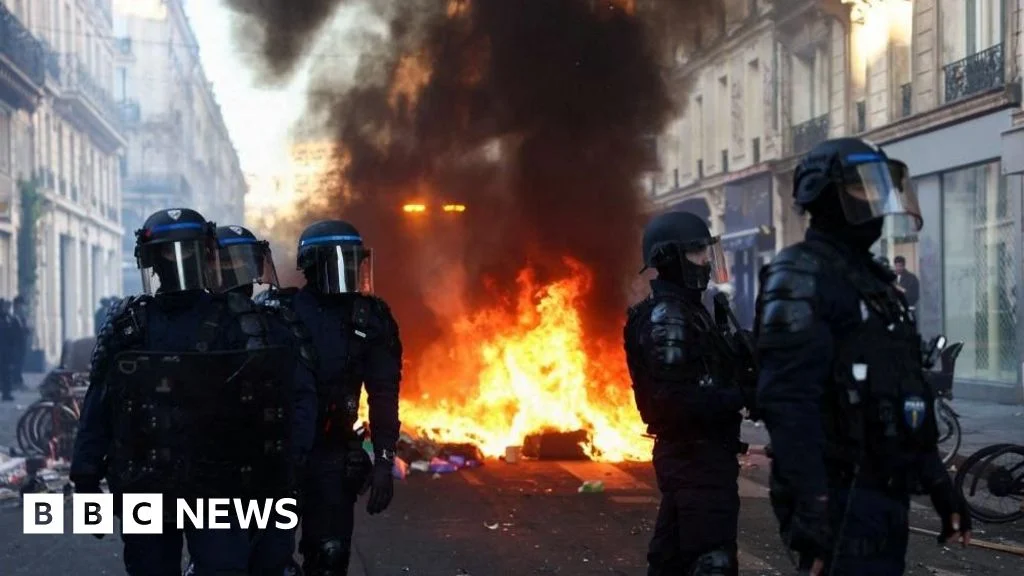
French President Emmanuel Macron has issued a firm appeal for calm and order following a weekend of severe civil unrest that transformed large-scale demonstrations into widespread rioting, looting, and arson across multiple cities. Speaking in a national address broadcast from the Élysée Palace, the president urged participants in the demonstrations not to escalate the situation further, acknowledging that a collective sense of anger and shame is felt across the nation.
The Escalation of Protests and Nationwide Unrest
The weekend’s crisis began when approximately 550,000 demonstrators took to the streets for what were initially intended as peaceful protests against deteriorating public services—including schools—as well as the rising cost of living and fuel prices. However, the nature of the gatherings shifted dramatically as student protests from the previous month were joined by trade union members and various anti-government groups.
As the demonstrations evolved into one of the worst bouts of public disorder in modern French history, groups of rioters—some wearing balaclavas, masks, and dressed entirely in black—moved through Paris, Marseille, Lille, Lyon, and other towns. These groups set fire to buildings and vehicles, while widespread looting targeted commercial businesses. In Limoges, the devastation reached historic proportions on Saturday when rioters set fire to the ornate 19th-century city hall, causing the roof and clock tower to collapse as flames engulfed the structure. Local residents expressed deep shock over the destruction of heritage sites, noting the lasting impact on the community.
Government Response and Mass Arrests
In response to the unprecedented violence, the French interior ministry reported that roughly 2,400 people have been arrested nationwide. Security forces faced intense clashes, deploying tear gas, water cannons, and stun grenades while confronting crowds that hurled bottles and rocks. The ministry confirmed that about 1,000 police officers sustained injuries during Saturday’s operations, with seven officers in serious condition.
President Macron emphasized that a strict distinction must be maintained between the legitimate demands of ordinary protesters and the actions of individuals who chose to smash, destroy, and loot. Asserting that unbridled violence can never be justified, he confirmed that everyone involved will face justice. Furthermore, local prefects and mayors have been instructed to draft new protective measures for civic buildings and commercial shops, while the government promised full transparency regarding the police response. Prime Minister Sébastien Lecornu is scheduled to convene a crisis cabinet meeting to address the aftermath.
Political Divisions and Ongoing Fallouts
The severity of the unrest has starkly highlighted France’s deep political divisions ahead of the upcoming presidential election in April, which could pit the hard-right against the hard-left. Interior Minister Laurent Nuñez stated that while the right to demonstrate remains fundamental, severe outrages were committed by thousands of far-left individuals intent on targeting public buildings and confronting law enforcement, later joined by criminal delinquents engaged in widespread looting.
Political leaders offered sharply contrasting reactions to the crisis. Jean-Luc Mélenchon, leader of the hard-left La France Insoumise party, used social media to heavily criticize the interior minister and police leadership, accusing them of complete incompetence and labeling them specialists in organized chaos. On the opposite side of the political spectrum, Marine Le Pen, leader of the hard-right National Rally party, strongly condemned the political exploitation of public anger by factions that actively encourage violence. As cleanup operations remove shattered glass and debris from city streets, the country braces for further political and social fallout.