
Escalation of Unrest Across French Cities
France experienced a severe wave of disorder as nationwide demonstrations against living costs and educational hardships escalated into widespread violence. Authorities reported that at least 1,200 individuals were taken into custody while an estimated 550,000 participants took to the streets across the country.
The French interior ministry noted that the unrest involved targeted acts of violence carried out by hooded individuals in the capital as well as regional hubs including Marseille, Rennes, Toulouse, and Angers. Property damage was documented in multiple locations, spanning from Grenoble and Avignon to Montpellier and Valence.
Clashes, Fires, and Structural Damage in Paris and Beyond
In Paris, daytime marches initially maintained a peaceful atmosphere, with various participants describing themselves as pacifists seeking change. However, conditions deteriorated significantly as evening approached. Riot police deployed tear gas and water cannons against crowds while facing intense resistance.
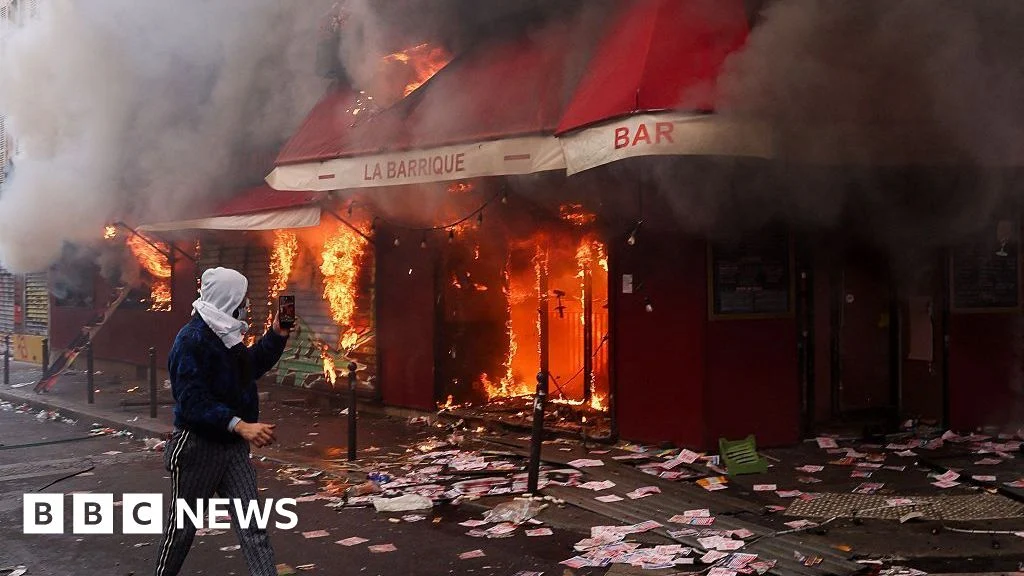
Demonstrators ignited street fires and torched vehicles in prominent urban zones such as the Place de la République. Retail establishments faced vandalism and looting, including clothing and food outlets in Paris, alongside an Apple store in Lille that was broken into and emptied. At least one restaurant was completely gutted by fire, and numerous police officers sustained injuries during the confrontations.
Regional areas also suffered major infrastructure damage. In Limoges, a severe fire at the town hall caused part of the building’s roof to collapse as fire crews worked to contain the blaze. In Lyon, Mayor Grégory Doucet described the burning of the city’s historic tourist office as a tragedy, noting that local police reported hostile individuals obstructing firefighters. Additionally, in Saint-Étienne, a young man suffered severe hand injuries from a small explosive device.
Political Repercussions and Government Response
The widespread unrest unfolds during a sensitive political climate as France approaches an upcoming presidential election, with President Emmanuel Macron scheduled to leave office next year. Prime Minister Sébastien Lecornu condemned the extreme intensity of the violence and asserted that certain groups were utilizing the demonstrations as a preliminary phase for the political campaign.
Political figures exchanged sharp critiques regarding the causes and handling of the demonstrations. Hard-left leader Jean-Luc Mélenchon accused law enforcement of aggressive tactics against protesters while condemning arson and looting, drawing strong criticism from Lecornu. Meanwhile, National Rally leader Marine Le Pen argued that legitimate public grievances had been co-opted by the far left.
President Macron stated that individuals responsible for attacking public prefectures, businesses, and town halls would face prosecution and punishment. Prior to the latest escalation, the government attempted address public grievances by promising thousands of additional supply teachers to combat staff shortages in secondary schools, though demonstrations have continued to intensify.