
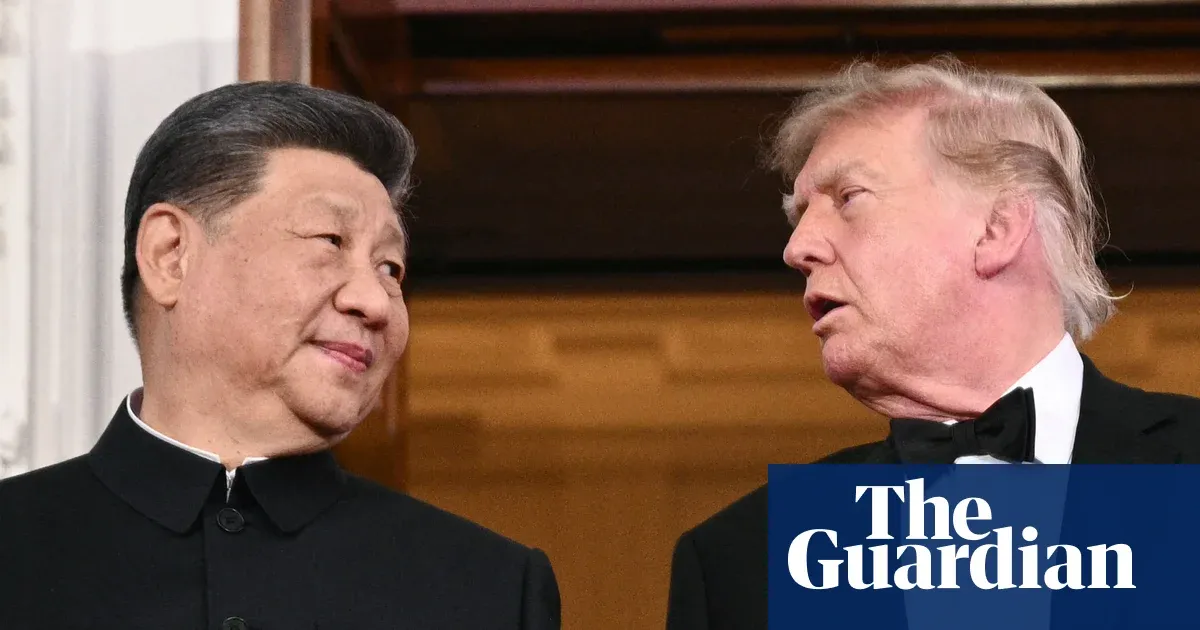
A high-visibility state summit at the White House between U.S. President Donald Trump and Chinese Leader Xi Jinping concluded with elaborate diplomatic honours, a short-term extension on trade war tariffs, and shared rhetoric on artificial intelligence, even as core geopolitical divides remained unresolved. Marking Xi’s first visit to Washington in over a decade, the gathering blended intense symbolic protocol with a concise 90-minute closed-door meeting that critics and diplomatic observers noted prioritized spectacle over concrete policy breakthroughs.
Ceremonial Grandeur Meets Diplomatic Friction
The state visit began with an unusual protocol departure when President Trump personally welcomed Leader Xi on the tarmac at Joint Base Andrews, complete with a red carpet and a military flyover by a B1 bomber. The gesture marked the first time a sitting U.S. president greeted a foreign leader upon arrival at the airfield since Barack Obama met Pope Francis in 2015. Protocol displays continued at the White House, where Chinese flags hung alongside American flags above the Oval Office, and Trump guided Xi on a personal tour of a newly constructed South Lawn helipad, pointing out its granite construction.
Despite the grand backdrop, political opponents and foreign policy analysts raised concerns over the summit’s substance. A group of Senate Democrats voiced sharp criticism, arguing the event prioritized theatrical display above tangible progress on critical issues such as trade imbalances, military tensions around Taiwan, and foreign conflict involvement. Former U.S. diplomat Danny Russel observed that the two administration heads appeared to dedicate more time to ceremonial social engagements than direct negotiation. Russel characterized the interaction as a form of ceremonial distraction that fails to resolve pressing international matters, emphasizing that symbolic gestures cannot substitute for key economic deliverables like rare earth supply security.
Artificial Intelligence and the Policy Position
Technology policy took center stage during the bilateral exchanges, particularly regarding the rapid global rollout of advanced artificial intelligence systems. Ahead of the formal meetings, Trump posted on Truth Social, explicitly referring to advanced systems as “super intelligence” and signaling an unwillingness to introduce new federal regulatory constraints. Trump stated his preference to leave existing AI frameworks unchanged, asserting that Beijing held a similar perspective on minimal international oversight.
During his public comments, Xi offered a parallel emphasis on governance, remarking that both nations must ensure artificial intelligence development remains strictly under human control. Industry analysts suggest that despite the shared posture against immediate over-regulation, intense global commercial competition between American and Chinese technology sectors will likely constrain future agreements to symbolic declarations rather than binding treaties.
Trade Extensions, Taiwan Arms, and Media Bans
The primary concrete economic outcome from the summit was a formal agreement to extend the current pause on bilateral tariffs until January 10. Beyond extending the trade agreement deadline, few long-term economic commitments were finalized during the discussions. On territorial concerns, Xi urged the U.S. administration to actively oppose Taiwan independence, according to readouts from official Chinese state media Xinhua, while pressing for an end to American arms transfers to the island.
The military assistance issue remains a point of friction within Washington. Trump previously held a foreign military sales package to Taiwan—valued at approximately $14 billion—in abeyance, framing the approved weaponry as a strategic negotiating lever. In response, at least 19 Senate Democrats issued a joint statement demanding the immediate release of both the stalled $14 billion arms deal and an additional $1.3 billion in approved congressional security assistance funds for Taiwan.
Domestic coverage of the visit faced unprecedented operational friction. Major U.S. television broadcast networks declined to carry the leaders’ public remarks live, withholding direct video feeds in protest after the White House barred reporters from CNN, MS Now, and Politico from accessing summit events. Demonstrators gathered near the White House gates during the arrival ceremonies, voicing loud protests regarding regional governance in Hong Kong that could be heard as the leaders posed for official photographs.
Silicon Valley Executives Attend White House State Dinner
The summit concluded with a formal state dinner hosted by First Lady Melania Trump, featuring a curated culinary menu of yellow squash velouté, sesame-crusted sea bass, and vanilla crèmeux accompanied by sour cherry confit. The guest list drew prominent political figures alongside a heavy presence of executive leadership from the global technology sector.
Prominent corporate leaders in attendance included Apple Chief Executive Tim Cook, Amazon founder Jeff Bezos, Alphabet Chief Executive Sundar Pichai, OpenAI Chief Executive Sam Altman, Tesla Chief Executive Elon Musk, Nvidia Chief Executive Jensen Huang, and Meta founder Mark Zuckerberg. The concentration of top technology executives highlighted the high stakes that major American technology firms have in the ongoing diplomatic, trade, and AI policies governing relations between Washington and Beijing.