
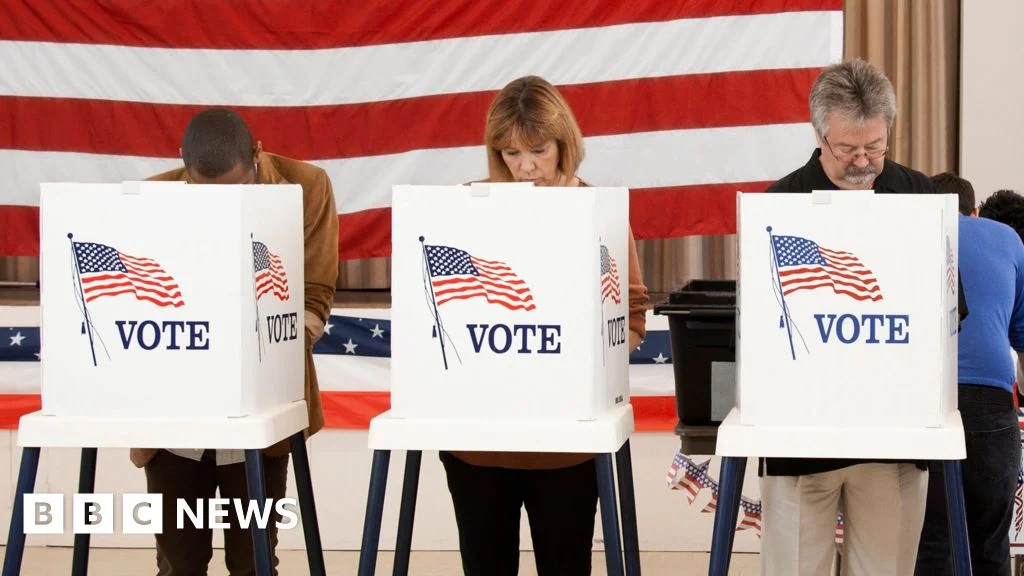
Following months of intense campaigning and billions of dollars in expenditures, election day has arrived for the United States midterm elections. Public opinion surveys indicate that Democrats hold a degree of advantage, though historical volatility and the unpredictability of voter behavior leave room for surprising results as ballots are tallied.
Political observers and analysts have outlined three broad trajectories for how the congressional balance of power could shake out once Americans complete voting. Each potential outcome carries distinct implications for the legislative agenda, regional race dynamics, and the remainder of Donald Trump’s presidential term.
Scenario One: A Significant Democratic Wave
Historical precedent often benefits the party out of power during midterm cycles. Combined with polling data pointing toward a historically unpopular president, ongoing economic pressures linked to a conflict with Iran that has inflated consumer costs, and contentious policies surrounding immigration enforcement and data center support, conditions have occasionally aligned to create major electoral waves.
In this high-end outcome for Democrats, the party would not only secure the House of Representatives by comfortably surpassing the 218 seats required for a majority, but they could also capture competitive toss-up districts and flip seats within traditionally conservative strongholds. Within the Senate, such a wave would necessitate sweeping victories across competitive battlegrounds, potentially yielding historic wins in states that have avoided electing Democrats for generations, such as Texas or Kansas.
A victory of this magnitude would provide Democrats with a comfortable legislative buffer, avoiding potential legal complications such as the dismissed Republican lawsuit in Alaska concerning ballot formatting. Achieving this outcome would rely heavily on heightened voter turnout and strong independent support, effectively reversing previous gains made by Donald Trump among Hispanic voters and young men. Early indicators for this scenario include Democratic resilience in targeted House contests across Florida alongside pickups in North Carolina, Michigan, New York, Virginia, and Kentucky.
Scenario Two: A Moderate Democratic Trickle
A more restrained outcome suggests that polling metrics may prove neither entirely accurate nor completely wrong. Under this hypothesis, Democrats secure enough lower-tier House contests to eke out a narrow majority, creating an environment where party leaders must continuously negotiate with progressive and moderate factions to advance legislation.
For the Senate, a modest shift would involve claiming a smaller number of accessible seats—such as North Carolina—while tougher contests in the conservative heartland remain out of reach. Factors preventing a broader sweep might include the resilience of incumbent Republican Senator Susan Collins in Maine, challenges for left-wing candidates in Michigan, or local ballot disputes in Alaska affecting Democratic contenders like Mary Peltola.
This outcome would likely transpire if strong early voting turnout among Democrats is met by a robust election-day surge from Republican voters mobilized by party leadership in red states. The resulting divided Congress would establish a strong foundation for ongoing political gridlock. Initial signs pointing toward this dynamic include a firmly Republican Florida coupled with isolated Democratic House pickups in states like Virginia and Pennsylvania.
Scenario Three: A Resilient Night for Republicans
A third possibility involves Republicans successfully maintaining control over both chambers of Congress. For this scenario to materialize, existing public opinion polls—which have historically underestimated Donald Trump’s base of support—would need to miss the mark, allowing Republicans to sweep the majority of closely contested toss-up races.
Sustaining Republican majorities would require exceptional voter turnout alongside unexpected support from independent and Hispanic voters. In the House, final control might hinge on protracted mail-in ballot counts in California, with Republicans ultimately securing a slim majority aided by favorable congressional map redraws in states like Texas, Florida, and North Carolina. Senate contests in conservative states would remain in Republican hands, alongside potential pickups in seats previously held by Democrats, such as Michigan.
Should this outcome unfold, the administration would likely interpret the results as a renewed electoral mandate, pressing forward with domestic and foreign policy goals backed by a friendly Congress. Early warning indicators for a strong Republican night include decisive re-elections for figures like Ashley Moody in Florida and Jon Husted in Ohio, alongside defensive holds in Pennsylvania and Virginia house races.